Read this before trusting a drawing
Limitations and known wrong readings
On structures not used in development, the composition and the metal–ligand bonds are reliable. The charges and oxidation states are less so, particularly for polymers and for disordered or mixed-metal structures. CIFlat reports these cases instead of resolving them silently, and its output for them should be read together with the report.
A drawing shows one molecule; the crystal may not
A structure in which a group is partly present, or a site is shared by two elements, is not one molecule, and the drawing shows only one. The report says what was chosen. The conventions are described under disorder and partial occupancy. The occupancy convention was reviewed and accepted by a chemist who took no part in writing the program, on all 12 unseen and held-out structures to which it applies.
Known wrong readings
Some readings are known to be wrong. They are listed here, and shown with the interpretive cases.
COD 1551217known wrong reading
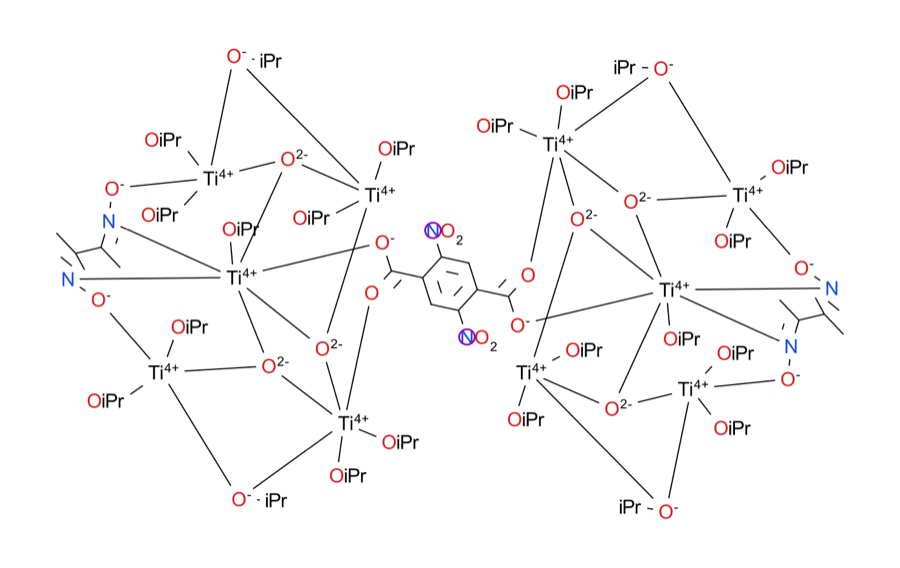
A half-occupied group whose symmetry copies lie in one molecule is drawn at every copy. Two Ti5 oxo clusters are joined by a nitroterephthalate ligand on an inversion centre. The half-occupied nitro group has its two images on the same ring, and the convention draws two groups where the compound has one. The formula check names the group and passes, but the reading is wrong. The rule that would correct it is not implemented.
COD 7009085known wrong reading
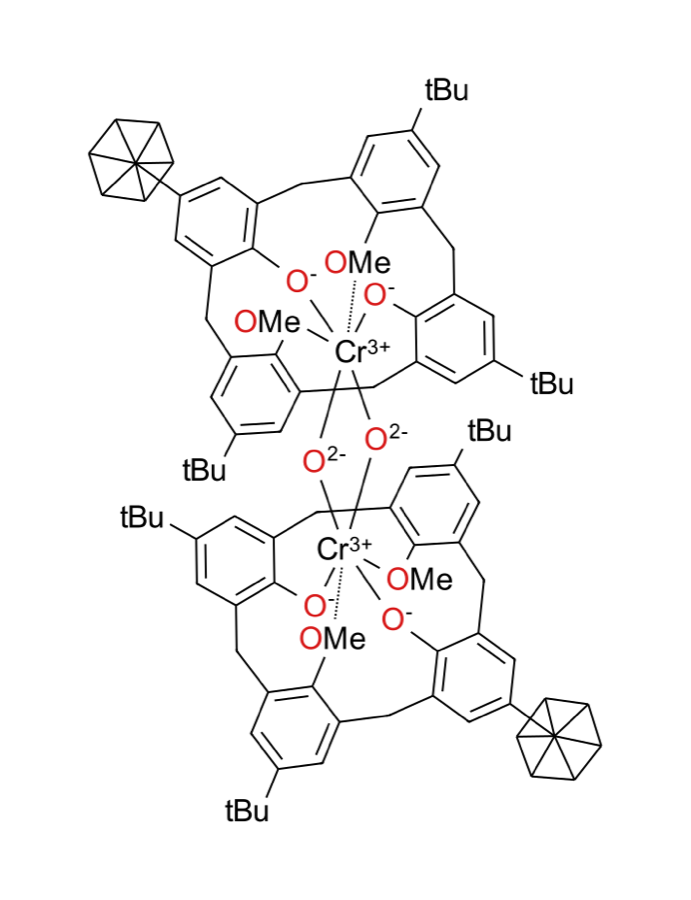
Alternative positions entered at full occupancy are not separated. Without occupancies to tell them apart, both positions are kept. The result is returned as invalid.
COD 1533436known wrong reading
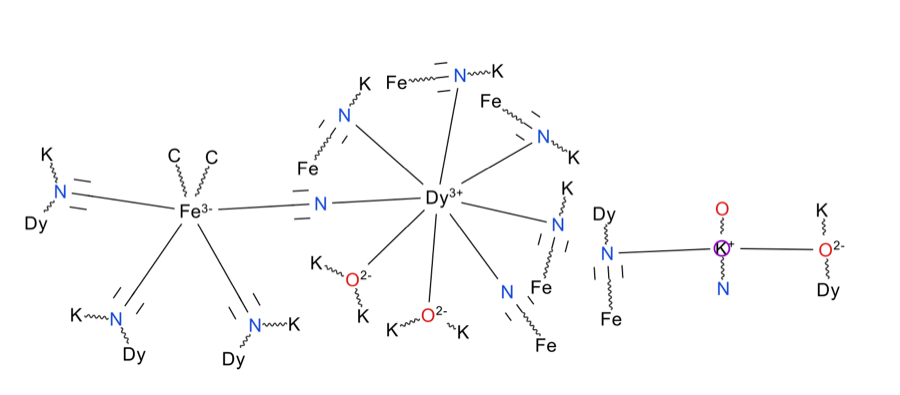
A water molecule without hydrogen atoms that bridges two metals is read as an oxide. The structure is left charged.
- A framework may not be recognised as a polymer (COD 4124177).
- A site shared by two metals gives a wrong composition and usually a wrong charge. One such structure was returned as ready (COD 7100107). In COD 1563093, each of the eight metal sites of a Cr7Ni ring is refined as 0.875 Cr and 0.125 Ni. Eight chromium atoms are drawn, and the structure as read has a charge of +1. Both facts are reported and the result is needs_review, but no drawing made from the sites alone can be right for such a structure.
Charges are the weakest part
About one unseen structure in five, and more than one polymer in three, is not charge-balanced as read: 195 of 238 unseen structures are neutral, but only 40 of 62 polymers. The following are not handled:
- radical ligands;
- free carbanions;
- metal–metal bonded clusters;
- mixed-valent compounds.
Hydrogen counts were not validated. When no ordinary set of oxidation states balances a structure, it is left charged with a warning rather than given an invented mixed valence.
Layout
- 20 of 238 unseen drawings break a drawing rule.
- 16 unseen drawings are hard to read: they have fifteen or more crossings at 0.12 or more per atom, or break three or more rules. A drawing that breaks no rule is not always readable either. Most are polyhedral oxo, alkoxide or sulfido cluster cores, which have no planar drawing. A longer search (240 s instead of 45 s) does not help them.
- A link line that starts inside a wide metal label of a bracketed polymer unit is not detected.
- Some graphs cannot be drawn without crossings. Label legibility is kept and the crossings are reported.
Limits of the validation
- The references used for validation are themselves fallible: the deposited formula, the depositors' bond lists, the compound names, and the program cell2mol.
- Apart from the convention review, the disagreements were examined by the authors only.
- The layout comparison covers free programs only and uses CIFlat's own rules. No assessment by chemists has been made.
- The unseen and held-out sets are no longer blind in the strict sense: defects found on them in earlier measurements were corrected by general rules.
Outside the program's guarantees
- Not every CIF dialect is supported. Missing or unrecognised symmetry can leave a molecule incomplete, and the program says so when that happens.
- CIF positions do not uniquely determine bond orders, protonation, oxidation states or stereochemistry. The rules that assign them are heuristics, and the report records what was assumed.
- Coordination stereoisomers (such as fac/mer) are not inferred.
- Abbreviated groups are labels, not expandable fragments in the CDXML. An expanded drawing can be requested with
--alternatives.