CIFlat

Documentation

Interpretive cases

These are the situations in which the program must interpret the file rather than transcribe it. Each comes with its definition, the convention CIFlat applies, how often it arose in the test structures, and worked examples. For each example the page says what the file contains, what is drawn, and what the correct chemistry is and how it is known.

The drawings are CIFlat's output, unedited unless a caption says otherwise. Examples marked known wrong reading show where a convention gives the wrong answer; they are kept here on purpose. Examples from the Cambridge Structural Database (CSD) are described without a drawing.

The three test sets

The unseen set is 240 COD entries drawn at random and never used in development (239 could be read); it is the primary evidence. The held-out set is 50 further COD entries of Cu, Ni, Co, Zn and Mn. The development set is the 46 CSD entries on which the program was developed.

The ten cases. Counts are the structures concerned in the unseen, held-out and development sets.
CaseConventionUnseen / held-out / dev.
A molecule completed by symmetrycompleted by symmetry52 / 12 / 19
Positional disorder with alternativesWithin each disorder assembly the group with the highest mean occupancy is kept whole and the others are left out; assemblies whose partly occupied sites lie within bonding distance of each other are resolved together.70 / 10 / 8
Atoms disordered across a symmetry elementA site of occupancy one half or less whose own symmetry image lies within bonding distance of it, or whose two images are bonded to the same atom of at least twice its occupancy, is one atom in two symmetry-related places, and one image is kept.None / None / None
A partly occupied group of the complexThe group is drawn whole, at every symmetry copy, when its occupancy is 0.5 or more, and left out when it is less.10 / 2 / 0
A site shared by two elementsThe element with the larger occupancy is drawn, the same at every symmetry copy.8 / 2 / 0
Partly occupied solvent molecules and counter-ionsIt is drawn whole, as a separate fragment, whatever its occupancy, since a solvent molecule is either shown or not; the formula check states by how many atoms the drawing then differs from the occupancies.22 / 6 / 4
Solvent removed from the model but kept in the formulaAtoms that the file does not place are not drawn.6 / 0 / 1
A formula written for another ZThe drawing follows the atom list.1 / 0 / 0
An atom list with more atoms than the formulaThe drawing follows the atom list, and the difference is named.2 / 0 / 0
Coordination polymersOne repeat unit is drawn for a chain, in square brackets (two symmetry copies of the asymmetric unit for a sheet or framework).62 / 19 / 6

A molecule completed by symmetry

Definition
The asymmetric unit holds a fraction of the molecule, which lies on an inversion centre, a rotation axis or a mirror plane; the rest is generated by the symmetry operators.
How often
The main molecule had to be completed by symmetry in 52 of the 239 unseen structures that could be read, in 12 of the 50 held-out and in 19 of the 46 development structures; the asymmetric unit sufficed in 125, 19 and 21; the remaining 62, 19 and 6 are polymers, for which symmetry is always needed.

COD 2224481held-out set
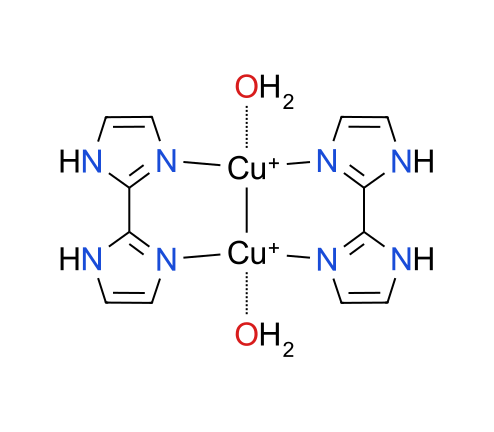
COD 2224481 as drawn by CIFlat, unedited: completed by symmetry

What the file holds and what is drawn. Bis(μ-2,2'-biimidazole)bis[aquacopper(I)] sulfate, space group C2/c, Z = 4. The file lists one copper atom, one biimidazole molecule, one water molecule and a sulfur atom on a twofold axis with two oxygen atoms. CIFlat generates the other half of each ion and draws the dinuclear cation (shown) and, as a separate fragment, the sulfate ion; it assigns copper(I) and bonds the two copper atoms, which are 2.596 Å apart (a contact that the depositor's bond list also contains).

The correct chemistry, and how it is known. The deposited formula is C12H16Cu2N8O6S with Z = 4 in a space group with eight general positions, so the formula unit is twice the asymmetric unit; the composition drawn equals it. The compound name, which the program did not read, describes a dinuclear biimidazole-bridged cation of copper(I). An earlier version of the program drew the sulfate ion as SO2; the formula check reported this as a program error, because fully occupied oxygen sites had been left out, and it was corrected by a general rule.
CSD WURYIRdevelopment set

What the file holds and what is drawn. The file lists the atoms of the asymmetric unit: one copper atom, its ligands and half of an oxalate group that lies across an inversion centre. Open Babel, reading the CIF, returns these atoms. CIFlat generates the other half and draws the dinuclear complex with the oxalate bridging two copper atoms.

The correct chemistry, and how it is known. The deposited formula is C26H34Cu2N4O6 with Z = 4 in space group Pbca, which has eight general positions; the formula unit is therefore twice the asymmetric unit, and the completed molecule has exactly this composition.

Positional disorder with alternatives

Definition
An atom or group is refined in two or more positions that cannot be occupied at once; each position has an occupancy and the occupancies add up to one. The positions are usually, but not always, marked with _atom_site_disorder_assembly and _atom_site_disorder_group.
Convention
Within each disorder assembly the group with the highest mean occupancy is kept whole and the others are left out; assemblies whose partly occupied sites lie within bonding distance of each other are resolved together. Unlabelled sites are taken as alternatives only in narrow circumstances (two sites of one element within 1.7 Å whose occupancies add up to one and which hold the same fully occupied neighbours).
How often
At least one site was left out as an alternative in 70 unseen, 10 held-out and 8 development structures. The files of 65, 10 and 6 structures carry disorder-group labels, and those of 95, 15 and 18 contain at least one partly occupied site.

COD 4103713unseen set

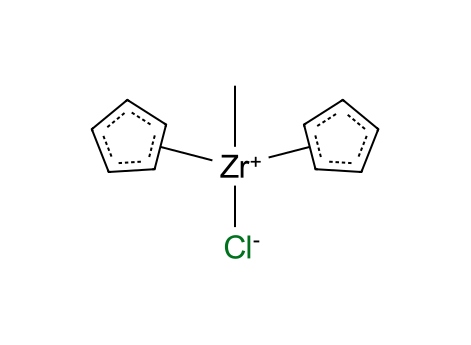
COD 4103713 as drawn by CIFlat, unedited: with disorder labels

What the file holds and what is drawn. A zirconocene methyl chloride, C11H13ClZr. The chloride and the methyl ligand are disordered over each other's positions: the file has Cl1 and C1B at occupancy 0.616 (group 1) and Cl2 and C1A at 0.384 (group 2), in one assembly, with C1A almost on top of Cl1 (angle C1A–Zr–Cl1 3.2°). The program keeps group 1 and draws one chloride and one methyl ligand on zirconium. The drawing shows the methyl group as a plain line, the two cyclopentadienyl rings delocalized, each joined to the metal by one line, and the formal charges Zr+ and Cl− that the program writes on the atoms.

The correct chemistry, and how it is known. All four sites together would give C12Cl2Zr; the deposited formula has C11ClZr, as the drawing has.

CSD KAMSAUdevelopment set

What the file holds and what is drawn. A pentanuclear nickel complex. A piperidine ring is refined in two orientations whose atoms are divided over several assemblies, each assembly holding a single group. Resolved assembly by assembly, both orientations survive and the ring is drawn twice on top of itself, with carbon atoms of valence nine and twelve atoms too many. Because partly occupied sites of the two groups lie within bonding distance, the program treats the assemblies as one disorder and keeps the more occupied orientation throughout.

The correct chemistry, and how it is known. The non-hydrogen composition then equals the deposited formula, C60N8Ni5O23.5.

COD 2234717unseen set

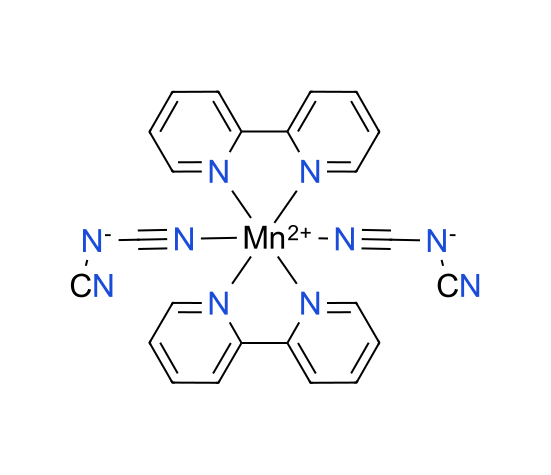
COD 2234717 as drawn by CIFlat, unedited: without disorder labels

What the file holds and what is drawn. Bis(2,2'-bipyridyl)bis(dicyanamido)manganese(II). The central nitrogen atom of one dicyanamide ligand is refined at two sites, N6 and N6A, each of occupancy 0.5, bonded to the same two carbon atoms (angle N6–C21–N6A 65.6°), with no disorder label. Kept together they give a four-membered ring and eleven nitrogen atoms. The program reads them as one atom in two places, keeps one, and draws the complex with ten.

The correct chemistry, and how it is known. A dicyanamide ion, N(CN)2−, has one central nitrogen atom; the deposited formula, C24H16MnN10, and the compound name agree with the drawing.

Atoms disordered across a symmetry element

Definition
A site of occupancy one half or less lies so close to a symmetry element that the site and its own image cannot both be occupied. The file contains one site; the disorder appears only when the symmetry is applied.
Convention
A site of occupancy one half or less whose own symmetry image lies within bonding distance of it, or whose two images are bonded to the same atom of at least twice its occupancy, is one atom in two symmetry-related places, and one image is kept. The partly occupied atoms bonded to the image that is left out go with it.
How often
The program does not record this case separately from the other alternatives, so no count can be given, and no example from the unseen or held-out sets has been identified. A related case in the unseen set, in which the rule is not applied and should be, is COD 1551217 (see 'A partly occupied group of the complex').

CSD AWESIEdevelopment set

What the file holds and what is drawn. A copper coordination polymer of a Schiff-base ligand with a propane-1,3-diyl link. The central carbon atom of the link has occupancy 0.5 and lies beside a twofold axis that passes through the link; its image is bonded to the same two carbon atoms. Both images together give a four-membered ring. The program keeps one image. Because the site is at an averaged position, one of its C–C distances is 1.24 Å; this is not taken as evidence of a double bond.

The correct chemistry, and how it is known. With both images the link would have four carbon atoms and the formula unit thirty. The deposited formula, C29H38Cu2N4O11, has twenty-nine, as the drawing has; the drawing differs from it only by half an oxygen atom of a partly occupied water molecule.

A partly occupied group of the complex

Definition
A ligand, or a group of atoms within one, is refined with an occupancy below one and has no alternative position: in a fraction of the molecules of the crystal the group is absent or replaced by something that was not modelled.
Convention
The group is drawn whole, at every symmetry copy, when its occupancy is 0.5 or more, and left out when it is less. The drawing then has more, or fewer, atoms than the deposited formula; the formula check names the group and the difference and passes. This convention was reviewed on all 12 structures in the unseen and held-out sets to which it or the related atom-list convention applies, by a chemist who took no part in writing the program, and was accepted.
How often
The case occurs in 10 unseen, 2 held-out and 0 development structures.

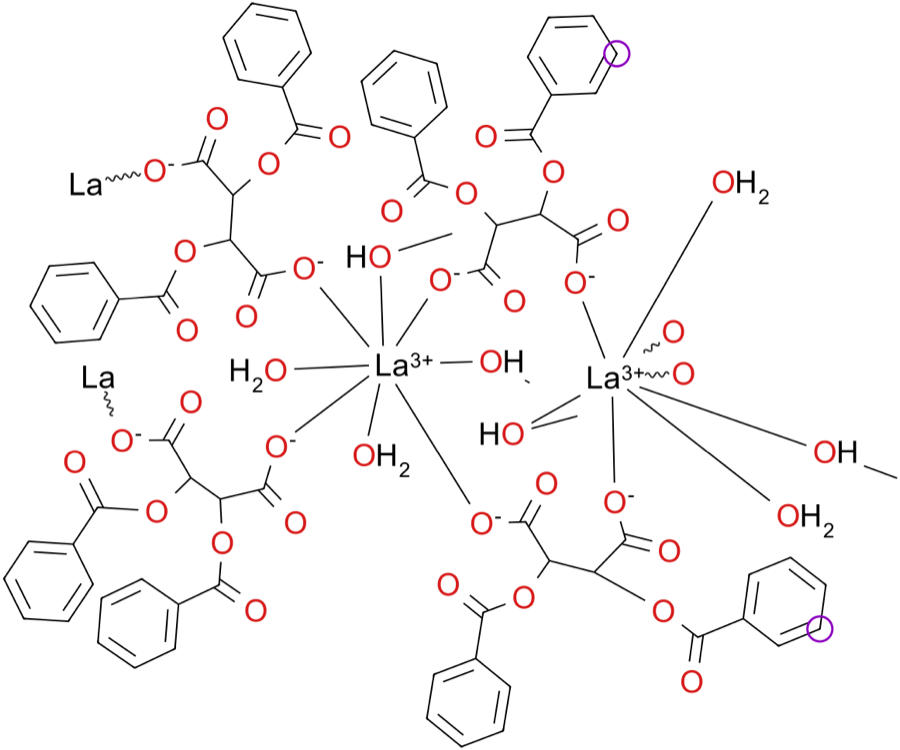
COD 7224648unseen set

COD 7224648 as drawn by CIFlat: drawn
Drawn with the OBz abbreviation switched off. The half-occupied carbon atom C23 is ringed in purple; the ring was added for the paper and is not part of CIFlat's output.

What the file holds and what is drawn. A chain polymer of lanthanum with O,O'-dibenzoyltartrate. One carbon atom of a benzoyl ring, C23, is refined at occupancy 0.5 and has no alternative position. The program draws the ring whole (the atom lies inside a group abbreviated OBz), so the drawing has one carbon atom more per formula unit than the deposited formula, C87H72La2N2O40.

The correct chemistry, and how it is known. A benzene ring has six carbon atoms: here the drawing is the compound, and the formula follows the refinement. The report names the site and states the difference.

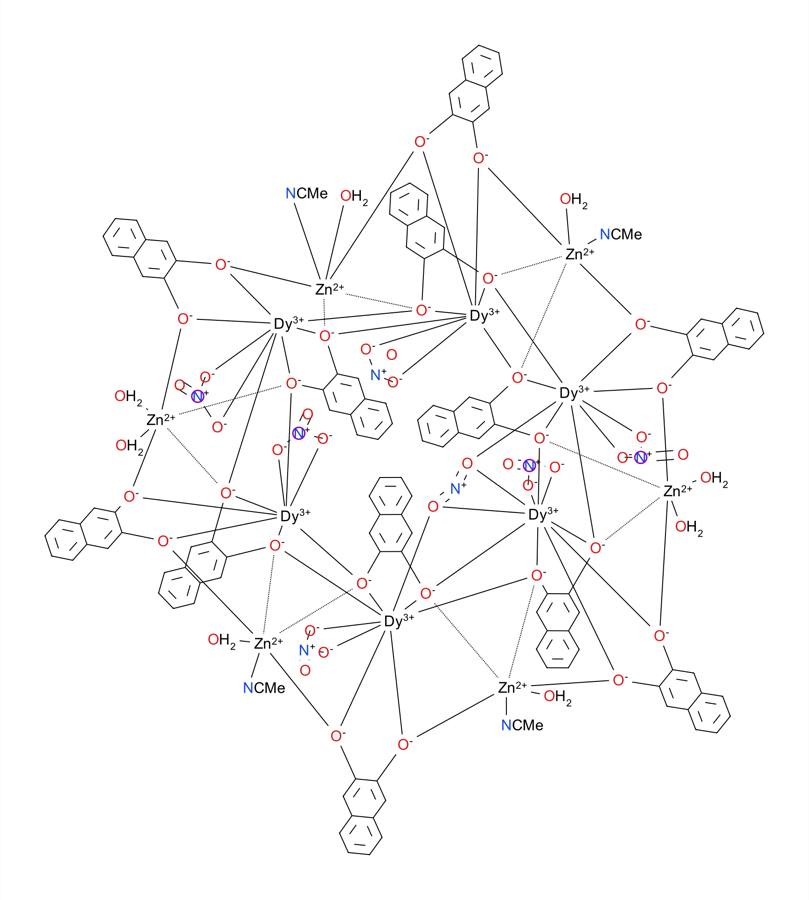
COD 7118556unseen set

COD 7118556 as drawn by CIFlat: drawn (crowded drawing)
Sites named by the formula check are ringed in purple; the rings were added for the paper and are not part of CIFlat's output.

What the file holds and what is drawn. A Dy6Zn6 cluster. A nitrate group is refined with its nitrogen atom N3 at occupancy 0.75. The program draws it at each of its symmetry positions, so that the drawing has eleven nitrogen atoms where the deposited formula, C128H104Dy6N10O52Zn6, has ten. The drawing of this cluster is crowded (21 bond crossings).

The correct chemistry, and how it is known. On average three of every four of these positions hold a nitrate group. No single drawing can show this; the drawing shows the fully nitrated molecule, and the report states that N3, refined at 0.75, is drawn at every position and that the drawing therefore has one nitrogen atom more than the formula.

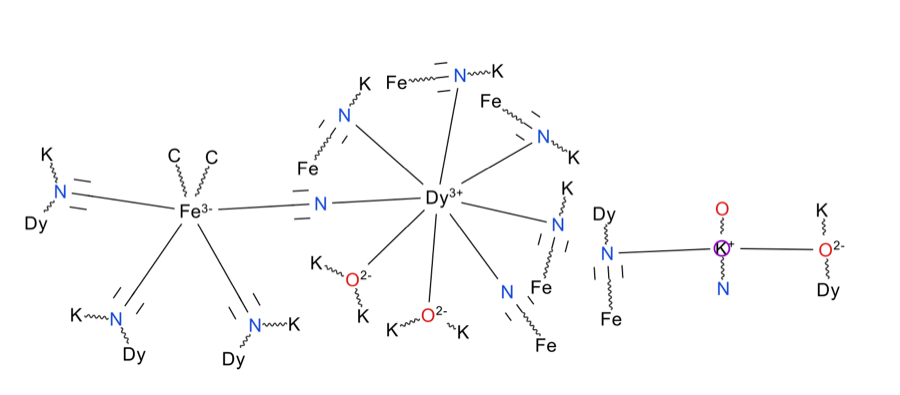
COD 1533436unseen setknown wrong reading

COD 1533436 as drawn by CIFlat: left out
Sites named by the formula check are ringed in purple; the rings were added for the paper and are not part of CIFlat's output.

What the file holds and what is drawn. KDy[Fe(CN)6]·3.49H2O. The water oxygen atom O3 has occupancy 0.492 and is left out. The picture also shows a potassium atom (ringed) drawn for a site shared by K and O, and water oxygen atoms read as oxide because the file has no hydrogen atoms for them.

The correct chemistry, and how it is known. The formula, which the depositor wrote with 3.492 water molecules, has 0.49 oxygen atoms more than the drawing on this account.

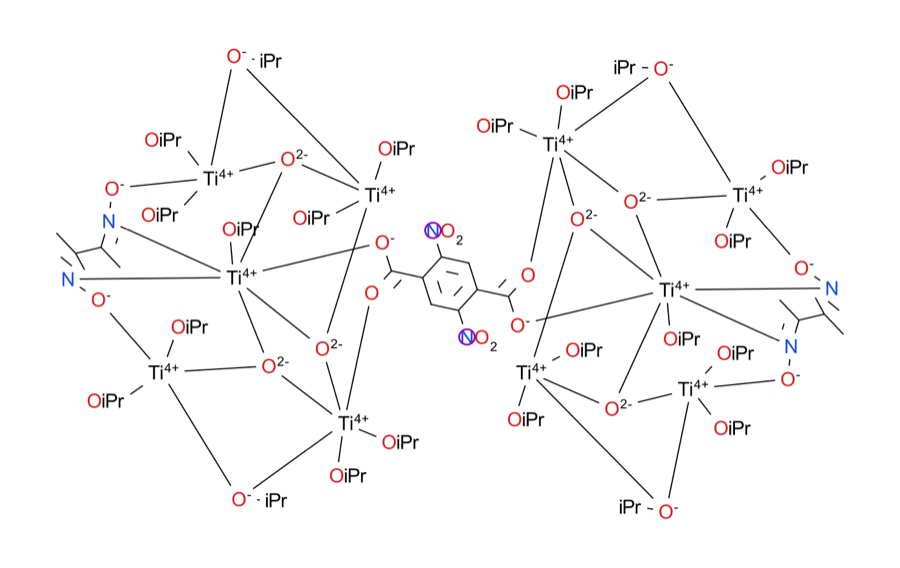
COD 1551217unseen setknown wrong reading

COD 1551217 as drawn by CIFlat: known wrong reading
Sites named by the formula check are ringed in purple; the rings were added for the paper and are not part of CIFlat's output.

What the file holds and what is drawn. Two Ti5 oxo clusters joined by a nitroterephthalate ligand that lies on an inversion centre, deposited as C82H169N5O36Ti10. The nitro group (N3, O14, O15) is refined at occupancy 0.5. The program applies the convention to each position and draws 2,5-dinitroterephthalate, with N6 where the compound has N5. The formula check reports the group and the difference and, under the convention, passes.

The correct chemistry, and how it is known. The two inversion-related positions of the nitro group are on the same benzene ring, so the ring carries one nitro group, disordered over two places. The reading is wrong. The rule that would correct it (occupancy times the number of copies in one molecule gives the number of groups) is not yet implemented.

A site shared by two elements

Definition
Two elements are refined at the same position with occupancies that add up to one (a solid solution, or substitutional disorder).
Convention
The element with the larger occupancy is drawn, the same at every symmetry copy.
How often
8 unseen, 2 held-out and 0 development structures.

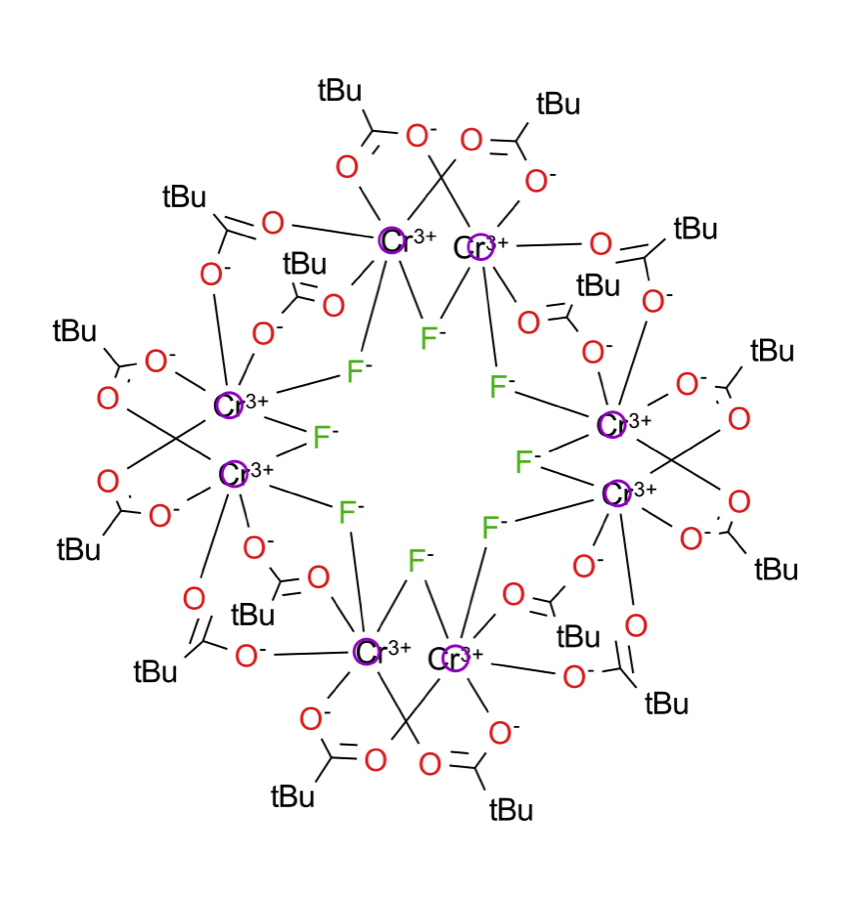
COD 1563093unseen set

COD 1563093 as drawn by CIFlat: majority element drawn
Sites named by the formula check are ringed in purple; the rings were added for the paper and are not part of CIFlat's output.

What the file holds and what is drawn. Contains the heterometallic ring [Cr7NiF8(O2CtBu)16]−. Each of the eight metal sites is refined as 0.875 Cr and 0.125 Ni. The program draws eight chromium atoms.

The correct chemistry, and how it is known. The compound name in the file and the deposited formula (Cr7Ni) show that each ring contains seven chromium(III) atoms and one nickel(II) atom, the nickel being distributed over the eight sites. The drawing therefore has one chromium atom too many and no nickel, and, because a Cr8 ring is neutral where the Cr7Ni ring is an anion, the structure as read carries a net charge of +1. Both facts are reported and the result is needs_review. No single drawing made from the sites alone can be right for such a structure.

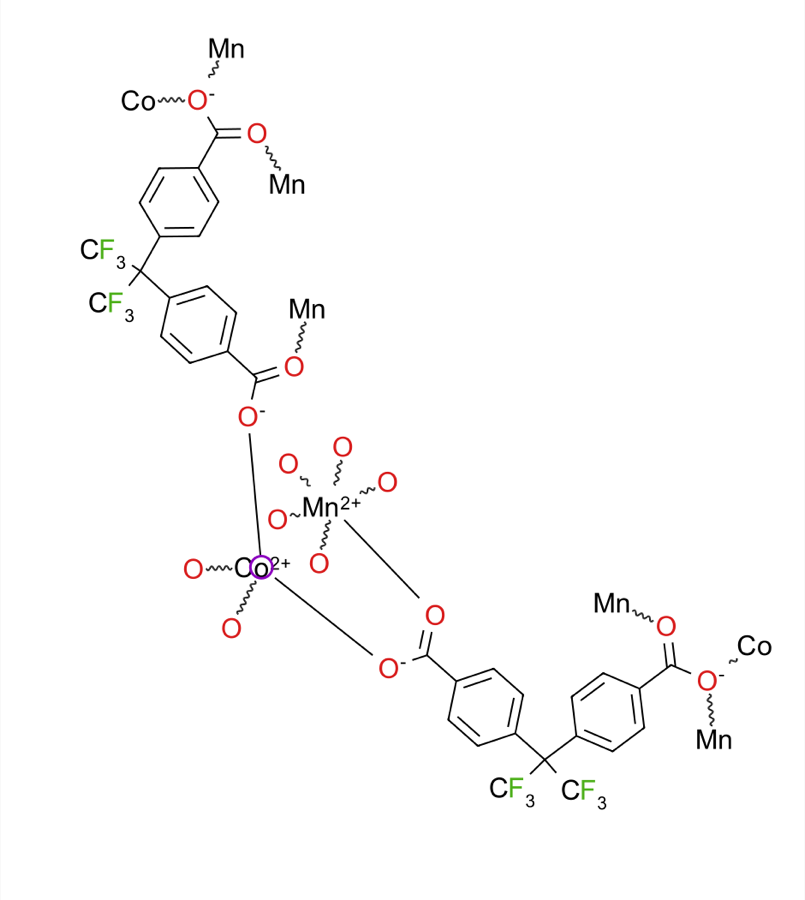
COD 4128063held-out set

COD 4128063 as drawn by CIFlat: majority element drawn
Sites named by the formula check are ringed in purple; the rings were added for the paper and are not part of CIFlat's output.

What the file holds and what is drawn. A coordination polymer with a metal site refined as 0.725 Co and 0.275 Zn, drawn as cobalt.

The correct chemistry, and how it is known. The deposited formula, C17H8Co0.36F6Mn0.49O4.17Zn0.14, states the mixed occupation; the drawing has 0.14 Co more and 0.14 Zn fewer per formula unit.

Partly occupied solvent molecules and counter-ions

Definition
A free molecule or ion, not bonded to the complex, is refined with occupancy below one.
Convention
It is drawn whole, as a separate fragment, whatever its occupancy, since a solvent molecule is either shown or not; the formula check states by how many atoms the drawing then differs from the occupancies.
How often
22 unseen, 6 held-out and 4 development structures.

COD 4350794unseen set

COD 4350794 as drawn by CIFlat: drawn whole
Sites named by the formula check are ringed in purple; the rings were added for the paper and are not part of CIFlat's output.

What the file holds and what is drawn. A rhenium complex. Seven carbon atoms of a toluene molecule are refined at occupancy 0.5. The program draws the complex and one toluene molecule (the picture shows the toluene fragment only, abbreviated).

The correct chemistry, and how it is known. The moiety formula of the file is C27H47Cl2N2P2Re, 0.5(C7H8): there is half a toluene molecule per complex. The report states that the toluene molecule is drawn whole and counted with 3.5 carbon atoms more than its occupancies give.

Solvent removed from the model but kept in the formula

Definition
The contribution of disordered solvent to the structure factors was removed with SQUEEZE (Spek, 2015) or a solvent mask; the atom list does not contain the solvent, and the deposited formula does.
Convention
Atoms that the file does not place are not drawn. The difference is attributed to the file when the file records the procedure.
How often
6 unseen, 0 held-out and 1 development structures. In a further 6, 1 and 2 structures the formula counts atoms that the atom list lacks and the file records no such procedure (for example COD 2007860, 3.98 carbon atoms); these are reported as 'formula has atoms the atom list lacks'. Differences of less than one atom between atom list and formula, which arise when occupancies are rounded in the formula, occur in 2, 1 and 0 structures.

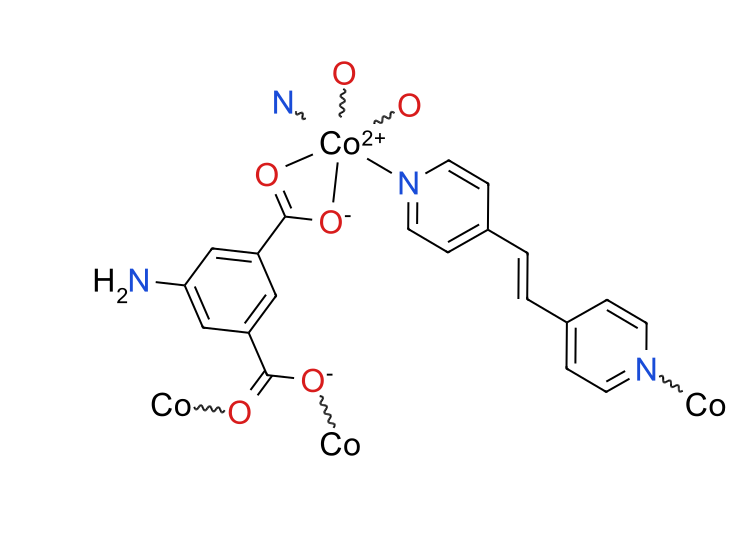
COD 7700899unseen set

COD 7700899 as drawn by CIFlat, unedited: solvent mask

What the file holds and what is drawn. A cobalt coordination polymer of 5-aminoisophthalate and 1,2-di(4-pyridyl)ethene, deposited as C20H19CoN3O6 with Z = 2. The atom sites add up to four oxygen atoms per formula unit, two fewer than the formula, and the file contains the record of a solvent mask, which gives the content of the masked void as water, 18.5 electrons per cell (about one water molecule per formula unit). The program draws one repeat unit, C20CoN3O4 without hydrogen.

The correct chemistry, and how it is known. The depositor's moiety formula, C20H17CoN3O5, 1[H2O], sets one water molecule apart in brackets as the masked solvent. The second oxygen atom that the formula has and the atom list lacks is written into the main part of the moiety formula; the file does not say what it is, and the program attributes both to the mask. The formula check passes with this reason; the result is needs_review, as for every polymer.

COD 7060419unseen set

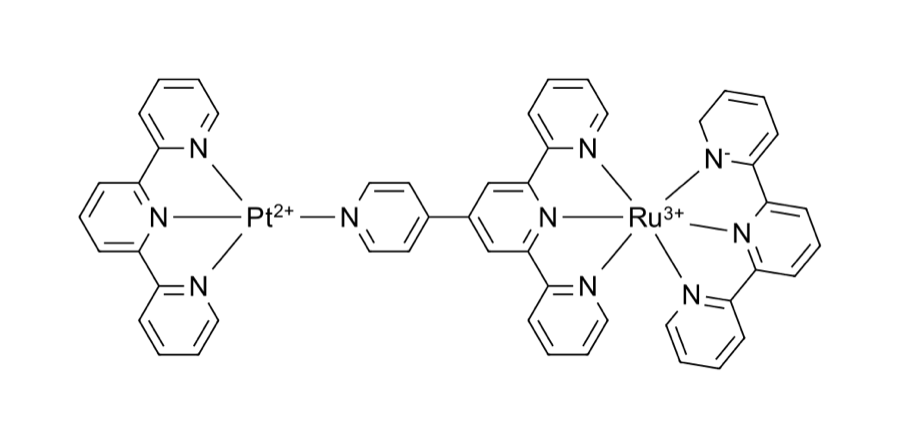
COD 7060419 as drawn by CIFlat, unedited: SQUEEZE

What the file holds and what is drawn. A Ru–Pt complex with hexafluorophosphate counter-ions. The formula has twelve carbon and five oxygen atoms that no atom site accounts for, and the file contains a SQUEEZE record.

The correct chemistry, and how it is known. The moiety formula is written by the depositor as C50H36N10PtRu, 4(F6P).[+3(C4H10O) +2(H2O)]: three diethyl ether and two water molecules, C12O5, are the solvent that was removed. The formula check passes with this reason. (The structure is not returned as ready, for reasons unrelated to the solvent.)

CSD JOBTEDdevelopment set

What the file holds and what is drawn. A Ni24 wheel whose formula includes C58Cl116 of unmodelled solvent.

The correct chemistry, and how it is known. The file records the SQUEEZE procedure.

A formula written for another Z

Definition
The atom list, counted over the cell and divided by the Z given in the file, yields a simple multiple or fraction of the deposited formula.
Convention
The drawing follows the atom list.
How often
1 unseen structure; none in the other sets.

COD 4316277unseen set

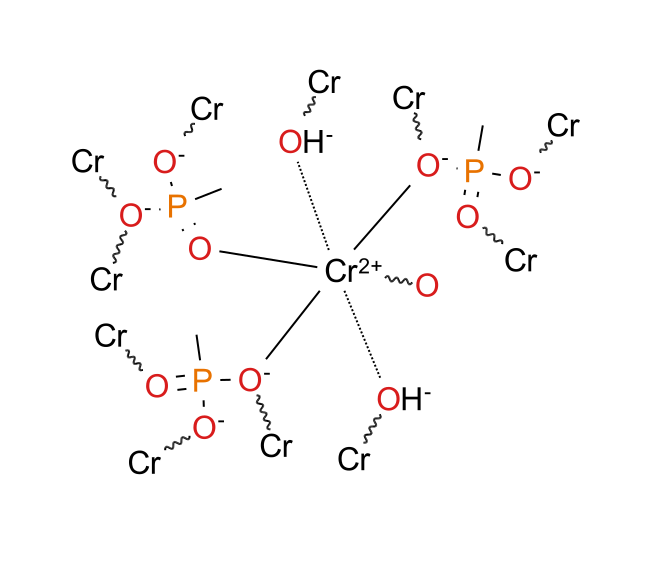
COD 4316277 as drawn by CIFlat, unedited: drawing follows the atom list

What the file holds and what is drawn. Chromium(II) methylphosphonate dihydrate, deposited as CH5CrO5P with Z = 8. The atom list holds one half of this formula per formula unit. The drawing follows the atom list, and the check passes with the class 'formula written for another Z'. The drawing is wrong in another respect: the two oxygen atoms that the compound name describes as water are drawn as hydroxide, the repeat unit is left charged, and the result is needs_review.

The correct chemistry, and how it is known. The cell volume is 590 Å3. Eight formula units would leave 74 Å3 for the eight non-hydrogen atoms of each, which is about half the volume such atoms occupy; the cell contains four formula units, as the atom list says.

An atom list with more atoms than the formula

Definition
The sites of the file, with their occupancies, add up to more atoms than the deposited formula has.
Convention
The drawing follows the atom list, and the difference is named.
How often
2 unseen structures (the second is COD 1551217); 0 held-out and 0 development structures.

COD 7009085unseen setknown wrong reading

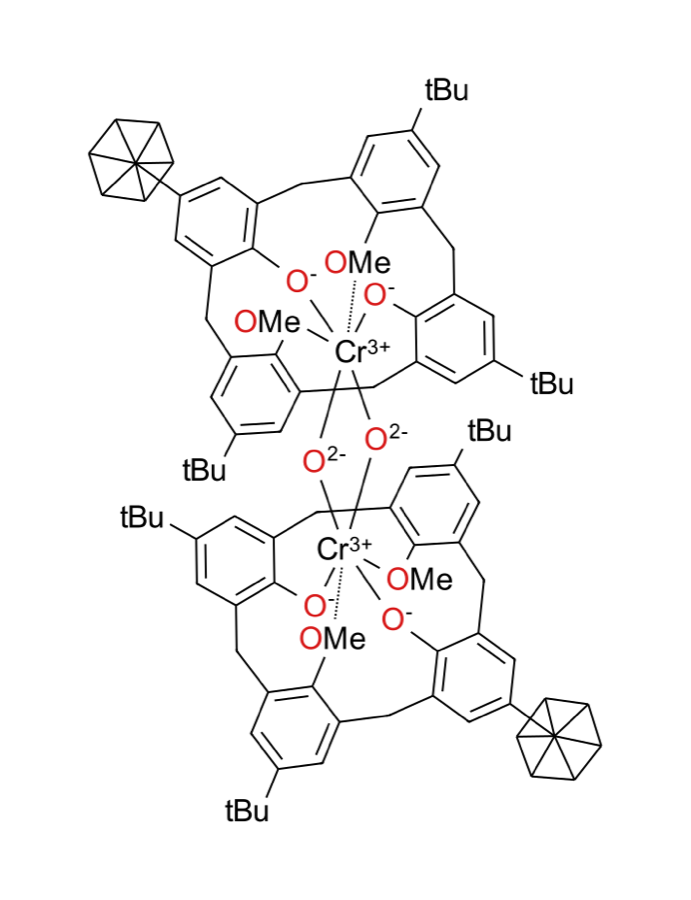
COD 7009085 as drawn by CIFlat, unedited: unresolved; invalid

What the file holds and what is drawn. A chromium complex deposited as C52H72CrO5. The atom list contains eleven carbon atoms more than the formula. The program's rule for alternatives entered at full occupancy does not resolve this structure: the groups are kept together, carbon atoms with seven to ten bonds result (the fused polygons of the picture), and the check for impossible features marks the result invalid.

The correct chemistry, and how it is known. The additional sites are alternative positions of disordered groups that were entered at full occupancy; the formula counts each group once. This is a failure of the program that is reported and not hidden: the formula check passes by convention, and the status is decided by the other checks.

Coordination polymers

Definition
The bonded network continues without end in one, two or three dimensions.
Convention
One repeat unit is drawn for a chain, in square brackets (two symmetry copies of the asymmetric unit for a sheet or framework). Where an excerpt is cut, the atom on the other side of the cut is shown as a ghost: its element symbol, joined by a wavy bond, laid out and judged like any other atom but not counted in the formula, the charge or the exported structure; a bracketed chain needs no ghosts. Atoms are counted by site weight, so that an atom shared between repeat units is counted once per formula unit, and the charge is balanced per repeat unit.
How often
62 of the 239 unseen structures, 19 of the 50 held-out and 6 of the 46 development structures are polymers; the other 177, 31 and 40 are finite. Of the polymers, 40, 13 and 6 are charge-balanced per repeat unit.

COD 2204966unseen set

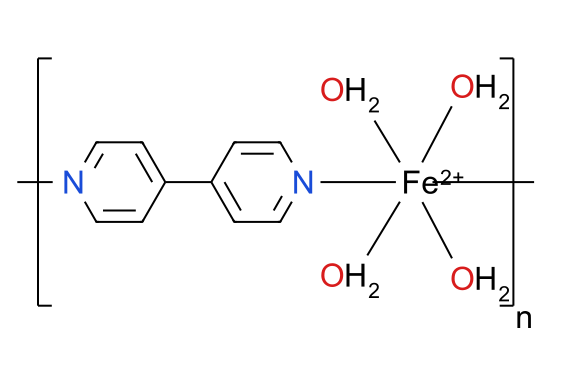
COD 2204966 as drawn by CIFlat, unedited: one repeat unit

What the file holds and what is drawn. catena-Poly[[[tetraaquairon(II)]-μ-4,4'-bipyridine] benzene-1,4-dicarboxylate]. The asymmetric unit holds half of each component. The program finds a chain, draws the repeat unit [Fe(H2O)4(4,4'-bipy)] in brackets and the benzene-1,4-dicarboxylate dianion as a separate fragment, and assigns iron(II).

The correct chemistry, and how it is known. The composition per formula unit, C18FeN2O8 without hydrogen, equals the deposited formula C18H20FeN2O8, and the oxidation state and the description as a chain agree with the compound name, which the program did not read.

COD 1533436unseen setknown wrong reading

COD 1533436 as drawn by CIFlat: charge not balanced
Sites named by the formula check are ringed in purple; the rings were added for the paper and are not part of CIFlat's output.

What the file holds and what is drawn. A water molecule bound to dysprosium also lies within bonding distance of potassium, has no hydrogen atoms in the file, and is read as an oxide because it has two metal neighbours. The repeat unit is left with a negative charge, the warning that the charge is not balanced is raised, and the result is needs_review.

The correct chemistry, and how it is known. The depositor's name, KDy[Fe(CN)6](H2O)3.492, shows that these oxygen atoms are water.